

 Polski
 English
 Українська
 Deutsch
 Italiano
 Français
News · Rotary Club Warszawa City
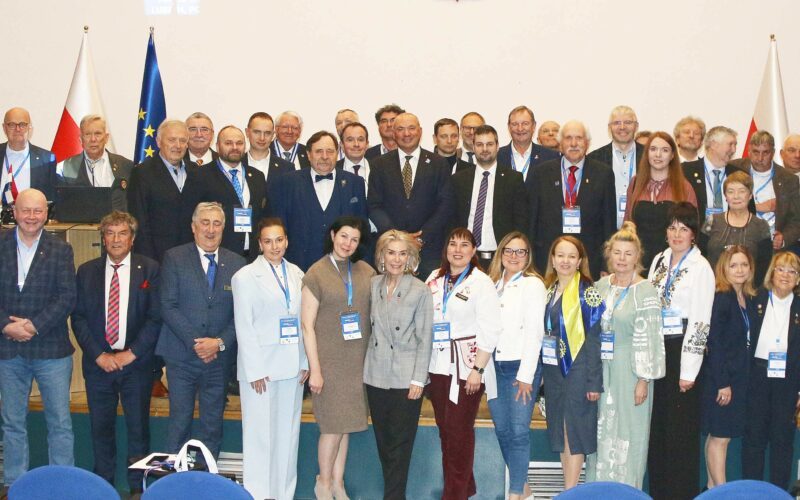
In Lublin, discussing peace for Ukraine
Preparations for the conference began in September 2025. Its main aim was originally to review and assess the work of more than 15 intercountry committees listed on the district website and to identify their needs and opportunities for further development. There were also plans to support committees needing additional engagement, including through the exchange of experience and the use of good practice developed in other parts of the world. Another important element of the preparations was work towards the official chartering of new committees, continuing initiatives already under way. None of this, however, actually required participants from abroad.
Many events devoted to peace and the most pressing challenges facing modern civilisation take place around the world under the auspices of Rotary Intercountry Committees (ICC). In May alone, similar meetings were organised in Cairo, Kraków, Riga, Tunis and Antalya, among other places.
Yet nowhere else does the subject of peace seem so closely linked to the reality around us as in Poland. This was, of course, about Ukraine and the role Rotarians have played in the relief effort. Some guests from abroad therefore came mainly to learn how support for Ukraine had been organised in a country close to the front line. It was also important for us to show our international guests what we could achieve. Those who came, from both abroad and Poland, were not disappointed, as the moving expressions of thanks from our international guests demonstrated.
As for the first part, the review of our committees’ work, the situation is unfortunately not very encouraging. At least five of them, for various reasons, have effectively ceased to exist and operate. It is reassuring, however, that new areas of interest have emerged and, above all, that there are Rotarians interested in this work. This made it possible to charter two ICCs in Lublin: Poland–North Macedonia and Slovenia, with Mateo Karczmarczuk heading the Polish section, and Poland–Netherlands, led by Wojciechem Zipserem. Both colleagues invite everyone interested to work with them. New groups will soon be formed as part of efforts to establish ICCs with Morocco, South Africa and Moldova.
The conference showcased the activities of several Polish committees, while our guests spoke about Rotary and ICCs in South Africa, Germany, Ukraine, the Netherlands, Slovenia, North Macedonia and Moldova.
Naturally, the main part of the conference was devoted to Ukraine. Given the wartime situation, the Poland–Ukraine Committee has taken a clear lead in this work. It should also be noted that, alongside district-level activities, themselves supported by the clubs, all Polish clubs have been involved on an unprecedented scale in supporting and coordinating their own and international assistance for Ukraine. The committee’s chair, Ryszard Łuczyn, described these activities and showed moving films about the scope of support for Ukraine, now extending beyond children to include mothers from Ukraine as well.
The conference’s guest of honour was PDG Annemarie Mostert from South Africa, who will take office as President of the ICC Executive Council on 1 July. Annemarie presented not only Rotary in South Africa but also her vision for the development of the intercountry committee movement at global and regional level. She appointed PDG Andrzeja Ludka, who served as President of the ICC EC in 2016–2018, to head the advisory team for the key area of development and constitutional matters.
An important event was the signing of a Memorandum of Understanding between District 9400 and Poland, strengthening relations between the South African and Polish Rotary leadership.
Beyond the formal sessions, the meeting reflected the deeper purpose of Rotary Intercountry Committees: building friendships between nations that create opportunities for meaningful service and long-term cooperation. Moments shared by delegates from many countries, particularly in support of Ukraine, highlighted the powerful role that Rotary relationships continue to play in times of global uncertainty.
An important moment was the presentation of the Richarda Pyritza Award. It recognises the work of partner Rotary clubs. The award is worth €3,000 and is funded by Districts 1940 and 2231 and RC Ratzeburg Alte Salzstrasse. It was presented by Andrzej Ludek, co-chair of the Award Committee, and Klaus Brodbeck, ICC National Coordinator for Germany, while the recipient was announced by Monika Kobylińska, Chair of the Poland–Germany ICC. The winner was the Polish-speaking Rotary Club Berlin Mickiewicz. Michael Kunat, Past President of that club and Chair of the Germany–Poland ICC, accepted the award.
The Governors from Ukraine, Olha Paliychuk, and Poland, Greg Gregorczyk, attended throughout the conference.
Seven ICC National Coordinators also took part.
The conference was organised by the ICC National Coordinator, the District and the Rotary Lublin Centrum club, which was celebrating its 30th anniversary at the time. The international guests also attended the gala marking 30 years of RC Lublin Centrum.
References
- ↑ “W Lublinie o pokoju dla Ukrainy”. Rotary Polska, rotary.org.pl. Original publication of the article (in Polish). [accessed 2026-11-05]